Some people have a bad habit of thinking a camping trip needs to justify itself. Enough driving. Enough planning. Enough distance from home to make packing the truck worthwhile.
Virtually anywhere outside can prove otherwise. And it doesn’t need to be a production.
There is real value in getting outside even when you only have a day or a night to spare. Life gets busy in pretty ordinary ways: work, errands, appointments, messages, chores. None of it is dramatic, but it all adds up, and it is easy to keep putting off the things that give you a little room to think.
Research backs up at least part of what people have been saying for a long time. A 2020 systematic review of nature exposure and stress looked at both perceived and physiological stress. All seven studies that measured physiological stress found lower stress responses associated with nature exposure, while five of six studies measuring perceived stress reported lower self-reported stress. Researchers looked at measures including cortisol, blood pressure, heart-rate variability and other markers of the body’s stress response.
More recent research points in the same general direction. A 2026 review published in Nature Human Behaviour examined a broad body of research on nature-based interventions for stress, anxiety and depression. The overall findings favored nature-based interventions, while the researchers also pointed out substantial differences in how the underlying studies were conducted and cautioned against assuming that one particular outdoor activity works the same way for everyone.
I’m not trying to turn camping into medicine. Sometimes I just need to stop participating in the busyness for a little while. One thing I know from experience is that when I come home after a night in the woods, my mood is usually better and I’m a lot more prepared to deal with Monday morning. (There’s probably a good reason the term "happy camper" found a place into nomenclature.)
The key is that receiving the benefits of the outdoors doesn’t require a week off.
One night can be enough
I have a place I return to often. It is close enough that getting there doesn’t become an ordeal, but far enough up a forest road that by the time I get out of the truck, home feels farther away than it actually is.
That may be one of the most useful things a campsite can offer. Not remoteness for the sake of being remote. Just enough distance that when you shut the truck door, you get the sense that society no longer needs anything from you for a while.
My definition of a perfect campsite has gotten less complicated over the years.
Flat ground certainly helps. Anybody who has spent a night slowly sliding toward one side of a tent understands that one.
There should also be enough room to actually settle in, preferably with something decent to look at once the chair comes out. Getting there should be interesting without requiring a recovery vehicle. And most importantly, it needs to be somewhere I actually want to return to.
Hanley Gap checks those boxes for me.
It’s not flawless. A trailhead sits nearby, and people occasionally wander through on their way to it. That doesn’t bother me much. I would rather have a place I can actually use than some theoretically perfect campsite that requires six hours of driving and a three-day weekend before I can justify going.
I also prefer camping near water, but for an overnight trip that isn’t much of an issue. I just bring my own.
There are also times when this place gets popular, especially during hunting season or summer holidays like Labor Day. You can drive up expecting some peace and discover four or five RVs parked where you planned to stay.
When that happens, which is rare, I have another spot farther up the road where the route dead-ends at a pretty good alternative. None of those things are deal breakers.
There are prettier places. More remote places. Places I would probably choose if I had several days to work with. But difficult access can make a great campsite a lousy option for a quick overnight trip.
There is another practical reason it helps to know a few dispersed places close to home: they are there when the campground system isn’t.
Popular campgrounds can book out weeks or months ahead, especially on summer weekends. Sometimes the choice isn’t between a reserved campsite and a dispersed one. It is between finding somewhere legal and accessible on public land or staying home because every reservable site disappeared before you made plans.
That is where a place like this becomes especially useful. It is not a backup because it is second-rate. It is a backup because it doesn’t require me to plan my life around a reservation window.
If Friday afternoon opens up and the weather looks good, I can go.
There is a lot of freedom in that.
I prefer dispersed camping anyway.
This location is just over an hour from my front door. Once I am there, things get pretty ordinary.
Peppers and onions hit the cast iron. Whatever meat happened to make it into my cooler joins them. Dinner somehow tastes better because there are pine trees behind the stove instead of a backsplash.
There is no established itinerary, and that is sort of the point.
Build a fire. Sit down. Watch daylight disappear.
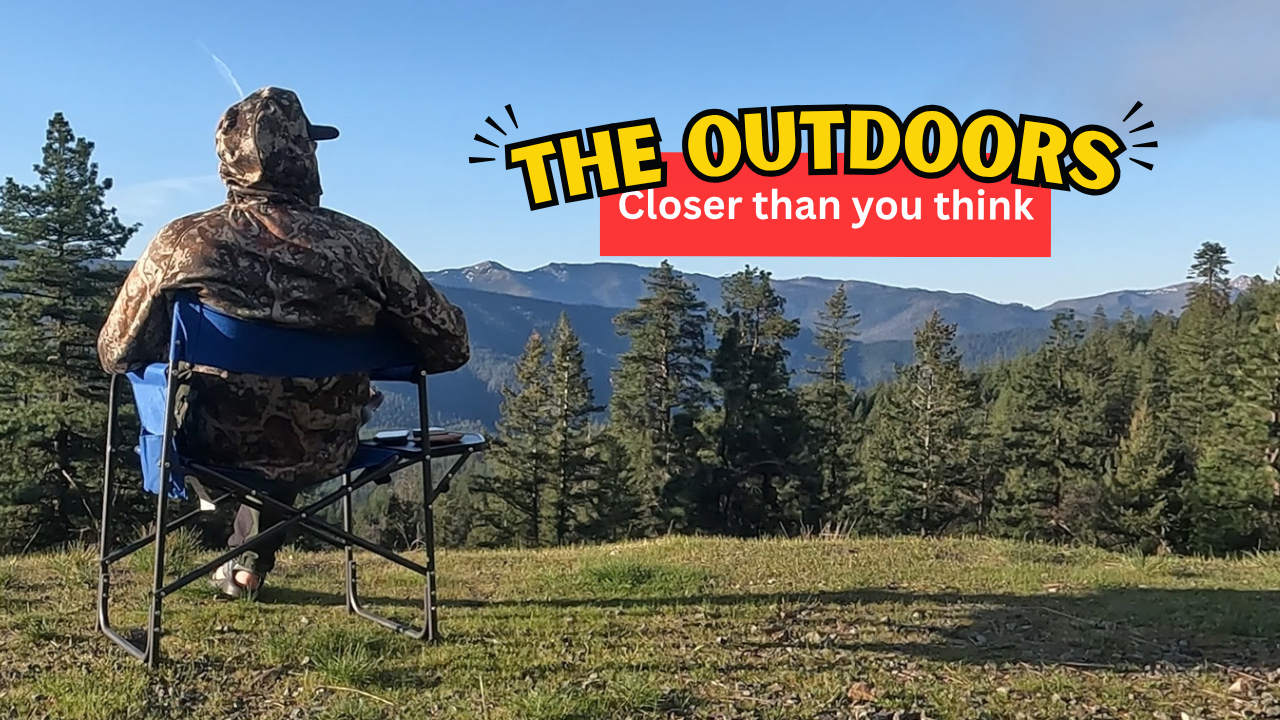
The distance from home matters a lot less once the fire is going. By nightfall, the nearby road is mostly irrelevant. There is a chair beside the flames, a black treeline, stars overhead and nowhere else I need to be.
Morning usually settles the argument
Mornings in the forest are usually the best part.
Water on the stove. Instant coffee. Fog working through the trees.
It doesn’t need to be revolutionary. It’s still better than drinking the same coffee at the kitchen table.
On this particular trip, the fog hung around camp while the surrounding country slowly appeared beyond it. A lookout sits farther up the road. A lake lies below. There are ridges and roads I have explored on previous trips, and plenty more I have yet to discover.
Being close to home does not mean I have seen everything worth finding. It just means I have a better chance of actually getting there.
The useful part is not the pin
I don’t think the most useful thing an outdoor content creator can give somebody is the exact place where they camped. I also don’t agree with treating public land like a private secret.
The more useful thing, at least to me, is giving somebody the information and tools to find places of their own.
This location happens to work for me because of where I live. Your version may be completely different.
I usually find places like this in an unremarkable way: driving forest roads, paying attention when something looks promising, remembering which roads went somewhere useful and coming back later.
No secret formula.
And I’m not interested in secret coordinates either.
If somebody asks me how to get somewhere I have shared, I will help them. I may give them the road, the access route and the information they need rather than dropping an exact campsite pin in their lap, because figuring out that last little bit for yourself is part of learning how to find these places.
My only real request is that you take care of what you find.
The useful skill is learning to notice the places around you that are close enough to use regularly instead of always assuming somewhere farther away must be better.
There are other tools I use: MVUM maps, satellite imagery and Forest Service information. Those deserve their own conversation.
This particular place was simpler.
Look at the public land near home. Learn the roads. Check access and current conditions. Stop when something looks interesting. Remember what worked.
Sometimes I write a road or location down on the notepad in my glovebox so I can look into it later.
Do that long enough and you begin building your own mental map of places worth returning to.
The film is built around Hanley Gap as the example rather than the destination itself. The broader point is that a worthwhile camping trip does not have to become a whole production, and that the most useful place may be the one close enough to actually use. That is also the central idea of the video.
My campsite is not really the point. Finding your own is.
And when you do find one worth returning to, take care of it.
There is a decent chance somebody else quietly likes that place too.